 Scan to follow










Summary
A technical failure in the UK's air traffic control flight processing system on Tuesday 8 September grounded departures across the country and triggered a cargo disruption that is still unwinding days later. Around 1,700 flights were cancelled on the day, with a further 150 cancellations following on Wednesday. Outbound international cargo capacity from London Heathrow fell from roughly 4,200 tonnes to 2,500 tonnes in a single day.
For shippers of urgent, perishable, pharmaceutical, automotive or high-value freight, the operational question is no longer what happened. It is what to do with the shipments that are still sitting somewhere in that backlog.
What happened
UK air traffic control provider NATS first reported a technical issue affecting flight departures at 13:46 local time on 8 September. By 15:25 it had identified the fault as sitting in its flight processing system — the software layer that receives flight plan data and re-encodes it for UK airspace management. A fix was implemented at 16:40 and NATS confirmed normal operation at 19:30, though it warned that recovery "has taken longer than we had hoped."
The knock-on effects continued well past the technical fix. NATS described it as "a very complex recovery" that "has created difficulties for the whole aviation network, from which it will take time to recover." Heathrow suspended arrivals for the remainder of Tuesday evening, and airlines spent Wednesday repositioning aircraft and crews that had been left out of place.
This is the third comparable failure at NATS since the widely reported August 2023 outage, and airlines have again called the resilience of the system into question. A full investigation has been promised.
Where the capacity went
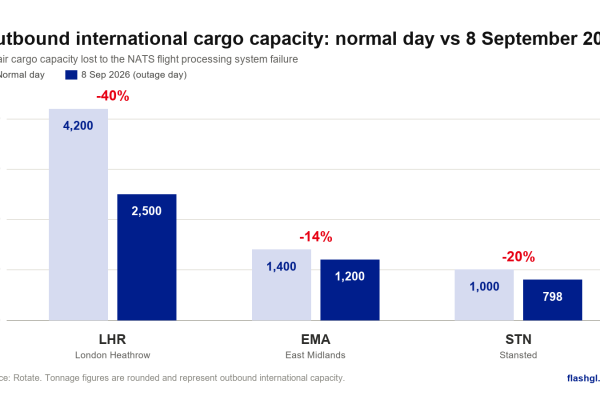
The cargo impact was not evenly spread. Data from Rotate shows how sharply outbound international capacity dropped at the three main UK cargo gateways:
| Airport | Outbound international cargo capacity | Change |
|---|---|---|
| London Heathrow (LHR) | 4,200 t → 2,500 t | -40% |
| East Midlands (EMA) | 1,400 t → 1,200 t | -14% |
| Stansted (STN) | 1,000 t → 798 t | -20% |
Heathrow's 40% drop matters disproportionately because it is where the bellyhold capacity on long-haul passenger services concentrates — and that is where most urgent general cargo actually travels.
What the industry is saying
IAG Cargo confirmed it has no booking restrictions in place and cargo can be booked as normal, with affected customers rebooked onto the next available service.
Virgin Atlantic Cargo expected to operate its planned flying programme on 9 September but warned that some shipments would continue to experience disruption, with teams prioritising the rebooking of impacted freight.
BIFA, the UK forwarders' association, was the most direct about the structural issue. Compliance and external affairs director Pawel Jarza noted that "a significant volume of airfreight is carried in the bellyhold of passenger aircraft, meaning cancellations, delays and diversions will also have disrupted the movement of goods." He flagged urgent, perishable, pharma, automotive, technology and high-value consignments as particularly vulnerable, and warned that knock-on effects would likely continue for several days.
What shippers of urgent freight should do now
1. Establish where your freight actually is.
The backlog is not uniform. Some consignments never left the origin warehouse; some are airside at LHR, STN or EMA; some are airborne and diverted. These three states require completely different responses, and the answer changes by the hour during a recovery.
2. Triage by real consequence, not by habit.
Line stoppage, a grounded aircraft, a clinical deadline and a missed retail launch are not the same problem. Rank affected shipments by the actual cost of each additional day of delay, then work down the list. Everything below the line can wait for standard recovery.
3. Decide: rebook or reroute?
Rebooking onto the next available service is free and usually right. Rerouting costs more and is only justified when the cost of waiting exceeds the premium. Make this comparison explicitly, per shipment, rather than by default.
4. Check that documentation still matches the movement.
A rerouted consignment frequently arrives at a different airport, on a different carrier, on a different day. That means customs entries, arrival notifications and delivery instructions need to match the new reality — a common source of secondary delay once the primary disruption clears.
5. Set a decision point in advance.
The single biggest driver of loss during a network disruption is passive waiting. Pick a threshold — 12 hours, 24 hours, one missed connection — at which you escalate to an alternative routing regardless of the latest recovery update.
What actually works when a hub stops
It is worth being direct about the limits here: no freight forwarder is untouched by an air traffic control failure. If aircraft cannot depart, an onboard courier cannot depart either. Anyone claiming business as usual during an ATC outage is not being straight with you.
What differs is the number of available paths once departures resume:
- Charter. The only option that genuinely sidesteps a congested hub schedule, because it is not tied to a published timetable or a specific slot at the affected airport. Most relevant for AOG, line-down and oversized or out-of-gauge freight.
- Reroute via an unaffected continental gateway. Flying into Amsterdam, Frankfurt or Leipzig and completing the final leg by road is often faster than waiting for a disrupted hub to clear, particularly for UK and near-Europe destinations.
- Cross-border road from continental Europe. For freight already on the continent, road movement via European hubs avoids the affected airspace entirely. UK-bound road legs depend on Channel crossing availability and require confirmation per shipment.
- Onboard courier (OBC). Valuable, but often misunderstood. During a ground stop an OBC is grounded too. The real value is in securing the first available seat the moment operations resume, with a courier physically escorting the consignment so it cannot be rolled off again.
- Hand carry. Same constraint. Effective for recovery acceleration, not for bypassing a closed airspace.
Be sceptical of any provider quoting firm transit times during a live disruption. Realistic answers come as ranges with conditions attached, confirmed per shipment.
The longer question
BIFA has called for "a clear assessment of what further measures are required to strengthen the resilience of the UK's aviation infrastructure" once normal operations resume. For shippers, the more useful takeaway is narrower: a meaningful share of urgent air freight depends on infrastructure that has now failed three times in three years, and on bellyhold capacity that exists only as a by-product of passenger schedules.
If your contingency plan assumes the published timetable will hold, it is not a contingency plan.
Moving time-critical freight into or through the UK this week? Our operations desk can assess your shipment against currently available routings and tell you honestly whether waiting or rerouting is the better call. [Request a quote] or contact the desk directly — for AOG and line-down situations we work to the clock, not the schedule.
Sources: Air Cargo News, NATS official statements, BIFA, Rotate capacity data, FlightAware/Cirium flight data.