 Scan to follow










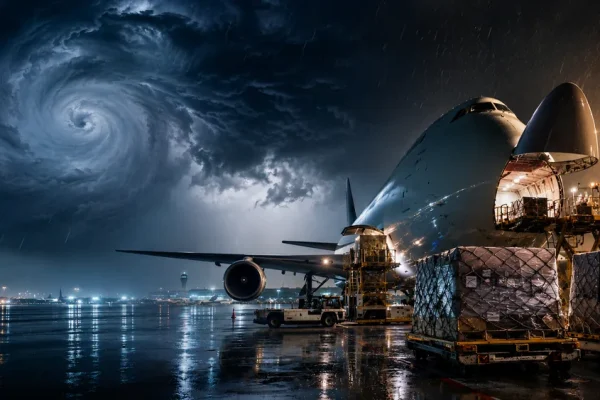
Typhoon Saudel—the 18th named storm of the 2026 Western Pacific season and a powerful super-typhoon—is bearing down on the East China coast, a fresh reminder that severe weather does not just disrupt travel. It can derail global supply chains within hours. As Saudel tracks toward landfall along the Zhejiang–Fujian coast on 27–28 August 2026, hubs such as Shanghai (PVG), Hangzhou, Ningbo, Wenzhou, Fuzhou, Xiamen and Taipei (TPE) are bracing for flight cancellations and cargo backlogs. Here is how businesses can prepare, and how time-critical logistics minimizes the impact.
Every year, tropical storms and typhoons disrupt some of the world's busiest aviation hubs across East and Southeast Asia. Airports in China, Taiwan, Japan, South Korea and Southeast Asia regularly face flight delays, cancellations and operational restrictions whenever severe weather approaches. The 2026 season has been exceptionally active: Saudel is one of four tropical cyclones spinning simultaneously in the western Pacific and South China Sea, and it follows Typhoons Bavi and White Dolphin, which also made landfall near Zhejiang earlier in the month.
The arrival of Typhoon Saudel once again shows how quickly weather can disrupt international air cargo. While travelers focus on cancelled flights, manufacturers, healthcare providers and airlines face a larger challenge—keeping critical supply chains moving.
For businesses shipping urgent cargo, every hour matters.
Weather Disruptions Affect More Than Flights
A typhoon rarely impacts only one airport. Strong winds, heavy rainfall and reduced visibility trigger a chain reaction across the regional air-cargo network, and the effect spreads far beyond the storm's landfall.
Common disruptions include:
- Flight cancellations and delays across multiple hubs
- Reduced cargo capacity as belly-hold and freighter space is pulled
- Aircraft repositioning ahead of the storm
- Ground-handling interruptions at affected airports
- Truck-transport delays on coastal roads and bridges
- Customs slowdowns during port and airport closures
- Missed flight connections and broken routing
- Congestion at alternative airports as capacity shifts inland
Saudel is arriving during an astronomical high tide, creating a wind, rain and tide triple threat along the Zhejiang–Fujian coast, with storm-surge risk around Ningbo and Taizhou. Even after the storm passes, major hubs may need several days to clear accumulated delays and cargo backlogs. For time-sensitive shipments, a delay of just 12 to 24 hours can create significant operational and financial consequences.
Which Industries Are Most Vulnerable?
Not every shipment is equally affected by severe weather. For industries operating under strict production schedules or temperature requirements, disruptions become costly fast.
Semiconductor Manufacturing
Modern semiconductor production depends on tightly synchronized global supply chains. Critical components, wafers, test equipment and manufacturing materials frequently move by air between Asia, Europe and North America. A delayed shipment can halt production lines worth millions of dollars.
Automotive Industry
Many automotive manufacturers run Just-in-Time (JIT) production. A single delayed electronic control unit (ECU), sensor or precision part can stop an entire line, with heavy financial losses for every idle hour.
Aerospace (AOG)
Aircraft on Ground (AOG) situations demand immediate action. When an aircraft is grounded waiting for a part, airlines face operational disruption, passenger inconvenience and steep daily costs. Every grounded hour adds up.
Pharmaceutical & Life Sciences
Temperature-sensitive medicines, clinical-trial materials, vaccines and lab samples often have narrow transport windows. Unexpected delays can compromise product integrity or delay patient treatment.
Why Traditional Freight Solutions May Not Be Enough
Under normal conditions, scheduled air freight is efficient and economical. During severe weather, however, standard logistics processes struggle to adapt quickly.
- Fully booked replacement flights
- Limited cargo space as capacity tightens
- Rapid, unpredictable schedule changes
- Longer transit times through rerouting
- Increased congestion at recovery hubs
Businesses needing immediate delivery require partners who can make real-time transport decisions instead of waiting for normal operations to resume.
How Time-Critical Logistics Responds
Time-critical logistics is built for situations where speed, flexibility and continuous monitoring are essential. Rather than relying on published schedules, it builds a solution around the shipment and the live network status.
On Board Courier (OBC)
When commercial passenger flights remain available, an experienced courier personally accompanies the urgent cargo on the fastest route, carrying it hand-to-hand through check-in, transit and customs. OBC removes the risk of misrouted or stranded hold cargo and suits high-value, small or irreplaceable shipments where chain-of-custody matters. Learn more about On Board Courier (OBC).
Next Flight Out (NFO)
NFO secures the earliest available commercial flight, reducing delays by using the first feasible departure. It is the default option when a shipment must move as soon as a flight opens, without waiting for a booked consolidation.
Air Charter
If commercial capacity becomes unavailable, charter aircraft provide an independent solution, moving critical cargo on a dedicated aircraft with no reliance on crowded scheduled services.
Alternative-Airport Routing
Experienced providers evaluate nearby airports with available capacity and coordinate dedicated trucking, customs clearance and airline connections to minimize disruption. Shifting the entry point by a few hundred kilometers can mean the difference between a shipment moving and a shipment sitting.
Frequently Asked Questions
What is time-critical logistics?
Time-critical logistics is a class of shipping services for shipments where delay is not an option. It combines the fastest available transport mode—OBC, NFO or charter—with 24/7 monitoring and active rerouting, so the plan adjusts in real time as conditions change.
How do you keep air cargo moving during a typhoon?
By planning before the storm hits: identifying critical shipments early, pre-positioning at unaffected hubs, securing the first available flights, and using alternative airports plus dedicated ground transport when the primary hub closes. Continuous visibility lets the team reroute the moment a flight or airport is compromised.
What is the difference between OBC and NFO?
OBC puts a courier on the flight with the goods for maximum control and chain-of-custody; NFO books the shipment on the next departing commercial flight without a courier. OBC suits high-value or sensitive items, while NFO is the faster default for standard urgent freight.
Which industries need time-critical logistics during storms?
Semiconductor, automotive (JIT), aerospace (AOG) and pharmaceutical or life-science shippers are most exposed, because their production lines, aircraft or patient treatments cannot wait for normal schedules to recover.
Preparation Is the Best Response
- Monitor weather forecasts affecting major logistics hubs.
- Identify critical shipments before disruption begins.
- Prepare alternative-airport options.
- Maintain emergency transport plans.
- Work with logistics providers offering 24/7 operational support.
- Ensure real-time shipment visibility.
Keeping Supply Chains Moving—No Matter the Weather
Typhoons, hurricanes, winter storms and other extreme weather are an unavoidable part of global logistics. While businesses cannot control the weather, they can choose how prepared they are to respond.
The companies that recover fastest are those with flexible transport strategies and experienced time-critical logistics partners who adapt in real time.
FlashGL provides global Time-Critical Logistics solutions, including On Board Courier (OBC), Next Flight Out (NFO) and Air Charter, helping customers keep critical shipments moving—even when severe weather disrupts normal operations. Request a quote or contact our 24/7 operations team to build a weather-resilience plan for your critical lanes.
When every hour matters, flexibility makes all the difference.